News
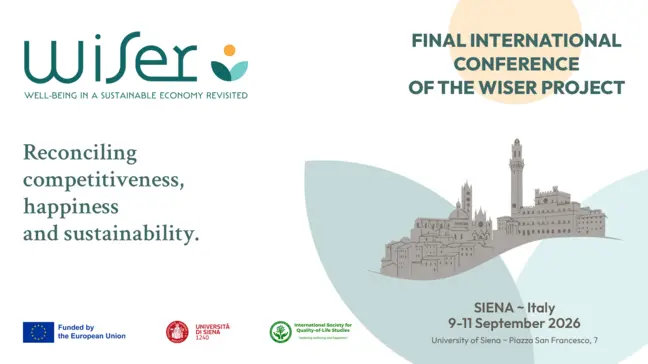
WISER International Conference “𝗥𝗲𝗰𝗼𝗻𝗰𝗶𝗹𝗶𝗻𝗴 𝗖𝗼𝗺𝗽𝗲𝘁𝗶𝘁𝗶𝘃𝗲𝗻𝗲𝘀𝘀, 𝗛𝗮𝗽𝗽𝗶𝗻𝗲𝘀𝘀, 𝗮𝗻𝗱 𝗦𝘂𝘀𝘁𝗮𝗶𝗻𝗮𝗯𝗶𝗹𝗶𝘁𝘆
University of Siena 9-11 September 2026
The WISER International Conference “𝗥𝗲𝗰𝗼𝗻𝗰𝗶𝗹𝗶𝗻𝗴 𝗖𝗼𝗺𝗽𝗲𝘁𝗶𝘁𝗶𝘃𝗲𝗻𝗲𝘀𝘀, 𝗛𝗮𝗽𝗽𝗶𝗻𝗲𝘀𝘀, 𝗮𝗻𝗱 𝗦𝘂𝘀𝘁𝗮𝗶𝗻𝗮𝗯𝗶𝗹𝗶𝘁𝘆,” to be held in University of Siena on September 9–11, 2026, will feature a roundtable discussion with five world-class keynote speakers, 39 plenary presentations, and an additional nine presentations at the associated Summer School (ISQOLS-WISER), which brings together dozens of young researchers to explore the themes of sustainability and ecological and social transition.
The conference will also focus on new research findings: from Europe’s continued failure to meet sustainability goals, to the cost of social and environmental degradation, to the effects of climate emergencies on people’s well-being.
The WISER Project has received funding from the European Union’s Horizon Europe research and innovation programme under grant agreement No 101094546
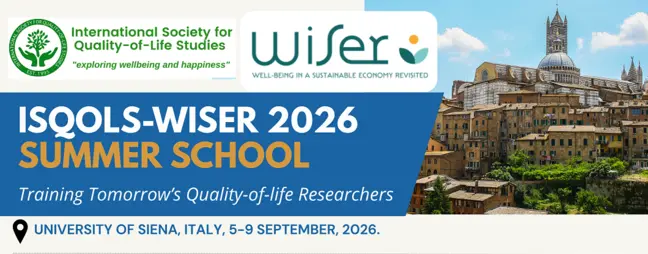
Call for applicants for the ISQOLS-WISER 2026 Summer School
September 5-9, 2026, University of Siena, Italy,
The Summer School is intended for early-career researchers, especially PhD students and advanced doctoral candidates.
The deadline for application is the 20th of June. For more details on the summer school and the link to apply, please follow this link.
Applicants may apply for one of two tracks:
1. Full ISQOLS–WISER Research Track including: the Summer School in Siena;the WISER Conference; andthe ISQOLS Winter Conference 2027 (date to be defined).
Applicants to this track must submit a short research proposal; a CV; a short motivation letter.
2. Summer School Only Track
Applicants to this track must submit a CV and a short motivation letter.
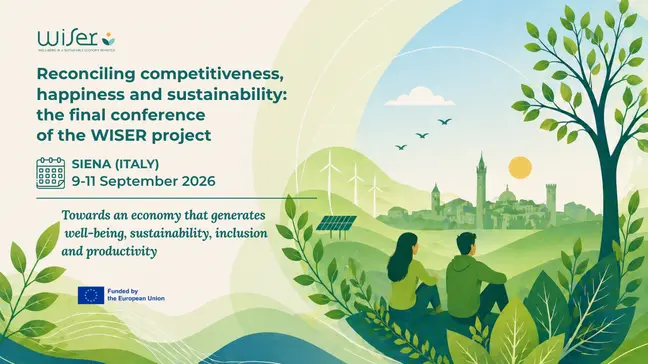
Call for Abstracts Final International Conference of the EU funded WISER Horizon project: “Reconciling competitiveness, happiness and sustainability”
September 9-11, 2026, University of Siena, Italy
Is it possible to reconcile the economy, environmental sustainability, and human well-being? A widespread view holds that the ecological transition will inevitably require sacrifices that may reduce individual well-being. Policies aimed at reducing emissions, limiting consumption, and transforming production systems are often portrayed as costly in terms of quality of life.
But is this necessarily the case? Can insights from studies on well-being help identify pathways toward an economy that is both environmentally sustainable and conducive to human well-being?
This conference aims to explore the relationship between happiness and sustainability from an interdisciplinary perspective. It seeks to bring together scholars working in economics, sociology, psychology, political science, environmental studies, and related fields to address a central question: can we design institutions, policies, and lifestyles that simultaneously enhance well-being and respect planetary boundaries?
Findings from the WISER Project suggest that a positive answer is possible. A growing body of research suggests that beyond a certain threshold, increases in income and consumption yield limited gains in well-being, while generating substantial environmental costs. Factors such as social relationships, trust, meaningful work, and access to public goods play a crucial role in shaping life satisfaction—often with a much lower ecological footprint. At the same time, the patterns that have generated growth across the past half century have undermined the foundations of human happiness—eroding social connections, weakening communities, and displacing the sources of a meaningful life. These WISER findings raise the possibility that a reorientation of economic systems toward well-being may also support sustainability.
The conference welcomes both theoretical and empirical contributions, as well as policy-oriented analyses.
ABSTRACT SUBMISSION
Submission Guidelines
Authors are invited to submit an abstract (max 300 words) or a full paper. Submissions should clearly state the research question, methodology, and main findings (if available).
Submission deadline: 21 June
Notification acceptance:30 June
Registration deadline:30 July
Find all the details here https://www.congressi.unisi.it/happiness2026/
Please send the abstract to wiserconference26@gmail.com
The following information must be included:
- Title of the presentation
- Name of the presenter (underlined, also in the submitted abstract) / Co-author(s)
- Presenter’s affiliation
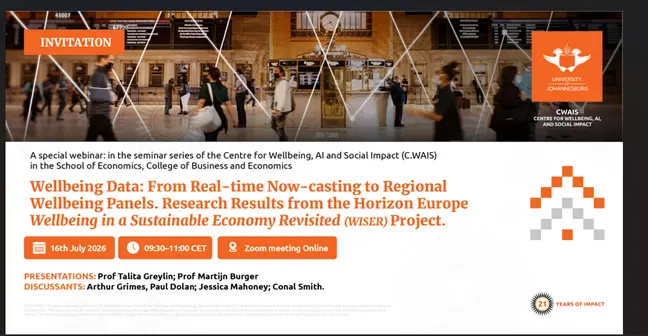
WISER Seminar | From Real-time Now-casting to Regional Wellbeing Panels | 16 Jul 2026 ONLINE
A seminar of the Centre for Wellbeing, AI and Social Impact (C.WAIS) presenting two data resources developed within WISER.
Presenters: Talita Greyling (Director, C.WAIS, University of Johannesburg) and Martijn Burger (Director, EHERO, Erasmus University Rotterdam).
Discussants: Arthur Grimes (Victoria University of Wellington and Motu Economic and Public Policy Research), Paul Dolan (London School of Economics), Jessica Mahoney (OECD) and Conal Smith (Kōtātā Insight and OECD consultant).
How can policymakers monitor wellbeing when societal conditions change faster than traditional surveys can capture? The first presentation will explore the now-casting of subjective wellbeing, using machine learning and high-frequency data to provide continuously updated measures of happiness and life satisfaction. The second will introduce a new harmonised European panel dataset containing more than three million observations from nine cross-national surveys, providing annual wellbeing estimates for over 200 European regions between 2000 and 2023. Together, these approaches demonstrated how real-time data, survey harmonisation, and advanced analytics can provide more timely, granular, and policy-relevant measures of societal progress.
DATE: 16 July 2026 | TIME: 09:30–11:00 Central European Time (CET)VENUE: Zoom meeting Online
Click here to RSVP
https://zoom.us/webinar/register/WN_cHXBV9pfSIWU89QmvtLI2g#/registration
Organised by C.WAIS, School of Economics, College of Business and Economics, University of Johannesburg. In collaboration with the Horizon Europe WISER (Wellbeing in a Sustainable Economy Revisited) Project.
Global South community perspectives on well-being and lived experience (online, recorded) | 6 July 2026 ONLINE
Hosted by Julia Föllmer, Javier Martínez and Carmen Anthonj (ITC Faculty, University of Twente), the session will present WISER case studies from Kenya, South Africa, Ghana and Peru on non-economic drivers of well-being: what improves well-being, for whom, where and under which conditions. It focused on how water and sanitation, social capital, governance, co-production and placemaking shape quality of life in disadvantaged communities, and identified cross-cutting policy lessons for the WISER Green Book and for dissemination beyond academia. Contributors: Caroline Kabaria, Dennis Musyoka and Dancan Owaga (APHRC, Kenya); Gail Anders and Michael Krause (VPUU NPC, South Africa); Michael Ayertey Nanor (KNUST, Kumasi, Ghana); Liliana Miranda Sara (Foro Ciudades para la Vida and IPCC Lead Author, Peru).
Monday, 6 July 2026, 14:00–15:30 CET
The webinar will be held in English via MS Teams and recorded.
Registration click here https://events.teams.microsoft.com/event/caeef23d-d59a-4a04-9678-466ca9ddd4a3@723246a1-c3f5-43c5-acdc-43adb404ac4d
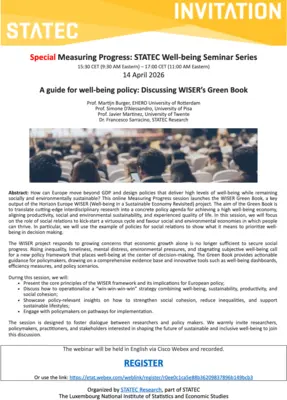
Special Measuring Progress: STATEC Well-being Seminar Series | A guide for well-being policy: Discussing WISER’s Green Book
15:30 CET (9:30 AM Eastern) – 17:00 CET (11:00 AM Eastern) 14 April 2026
Prof. Martijn Burger, EHERO University of Rotterdam
Prof. Simone D’Alessandro, University of Pisa
Prof. Javier Martinez, University of Twente
Dr. Francesco Sarracino, STATEC Research
Abstract: How can Europe move beyond GDP and design policies that deliver high levels of well-being while remaining socially and environmentally sustainable? This online Measuring Progress session launches the WISER Green Book, a key output of the Horizon Europe WISER (Well-being in a Sustainable Economy Revisited) project. The aim of the Green Book is to translate cutting-edge interdisciplinary research into a concrete policy agenda for achieving a high well-being economy, aligning productivity, social and environmental sustainability, and experienced quality of life. In this session, we will focus on the role of social relations to kick-start a virtuous cycle and favour social and environmental economies in which people can thrive. In particular, we will use the example of policies for social relations to show what it means to prioritize well-being in decision making.
The WISER project responds to growing concerns that economic growth alone is no longer sufficient to secure social progress. Rising inequality, loneliness, mental distress, environmental pressures, and stagnating subjective well-being call for a new policy framework that places well-being at the center of decision-making. The Green Book provides actionable guidance for policymakers, drawing on a comprehensive evidence base and innovative tools such as well-being dashboards, efficiency measures, and policy scenarios.
During this session, we will:
- Present the core principles of the WISER framework and its implications for European policy;
- Discuss how to operationalise a “win-win-win-win” strategy combining well-being, sustainability, productivity, and social cohesion;
- Showcase policy-relevant insights on how to strengthen social cohesion, reduce inequalities, and support sustainable lifestyles;
- Engage with policymakers on pathways for implementation.
The session is designed to foster dialogue between researchers and policy makers. We warmly invite researchers, policymakers, practitioners, and stakeholders interested in shaping the future of sustainable and inclusive well-being to join this discussion.
The webinar will be held in English via Cisco Webex and recorded.
REGISTER
Or use the link: https://etat.webex.com/weblink/register/r0ee0c1ca5e88b36209837896b149bcb3
30th Anniversary Conference of the International Society for Quality of Life Studies (ISQOLS)
WISER announce ITS participation in the 30th Anniversary Conference of the International Society for Quality of Life Studies (ISQOLS), taking place in Luxembourg (22-25 July).
This milestone event brings together researchers, practitioners, and changemakers from around the globe to explore the latest insights in quality-of-life studies and WISER is proud to be a partner, hosting 3 special sessions on 22,23 and 25 July.
These sessions will showcase cutting-edge research, interdisciplinary dialogue, and inspiring speakers who are studying and improving the future of wellbeing metrics and policy.
- Well-being for All through Urban Blue and Green
- Well-being Learnings from Africa and Latin America
- Spaces, Places and Measures of Wellbeing and Happiness
The 23rd Annual ISQOLS Conference is organized in collaboration with the Research Department of STATEC and the University of Luxembourg with the support of the Luxembourg Ministry of the Economy.
Read more about ISQOLS conference here
https://isqols.org/2025
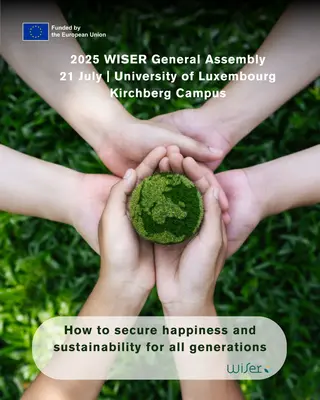
The 2025 WISER General Assembly | July 21
The 2025 WISER General Assembly on 21 July 2025 at the University of Luxembourg, Kirchberg Campus, brings together the researchers involved in the WISER project to present progress, updates, discuss methodologies and development across work packages. It’s a great opportunity to exchange insights, strengthen collaboration, and shape the next steps of the project.
Looking forward to connect, collaborate, and keep pushing forward innovation within the WISER framework: wellbeing, productivity, sustainability, and inclusiveness